
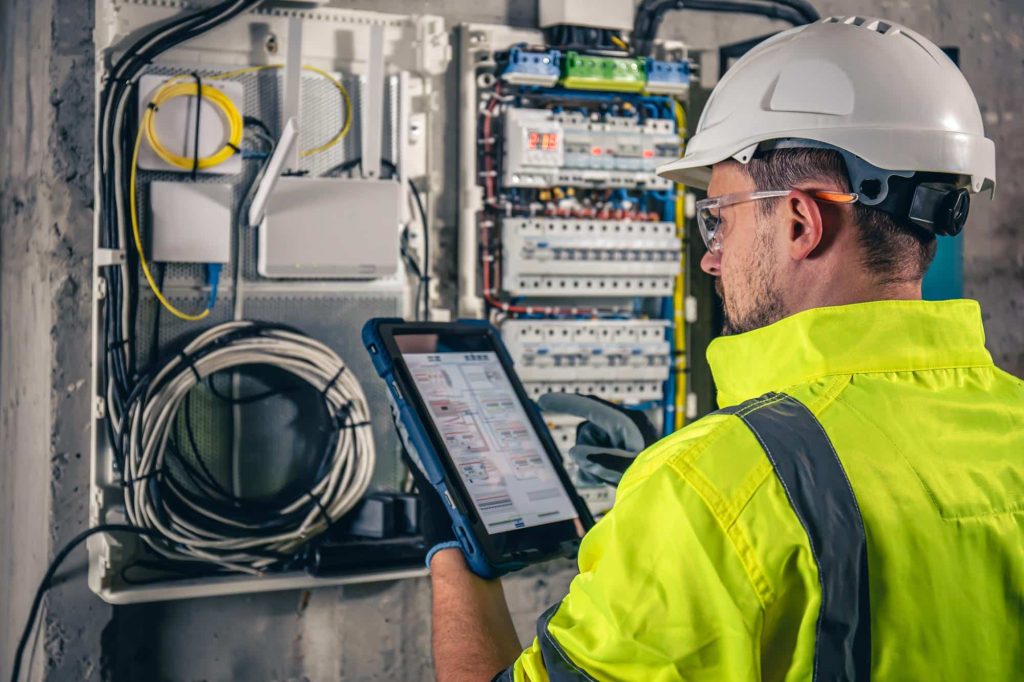
Your electrical panel can fail without a single dramatic warning. Many Chatham-Kent homes still run on 60-amp or 100-amp panels that no longer meet modern power demands or current safety codes. The real cost is twofold: a higher risk of fire, and a growing chance your home insurer will refuse or cancel your coverage.
For most homes, an electrical panel upgrade in Chatham-Kent costs $2,500 to $4,500 for a 100-amp to 200-amp service and protects your home, your family, and your insurance policy. This guide explains the silent signs of failure, the true risks, the 2026 costs, and exactly what the upgrade involves from the licensed team at JCP Electric Ltd., serving Chatham-Kent and Sarnia-Lambton.
What are the Silent Signs Your Electrical Panel is Failing in Chatham-Kent?
A failing electrical panel rarely announces itself. Instead, it shows small, easy-to-ignore symptoms long before a serious event. Watch for these common warning signs:
- Lights that flicker or dim when appliances turn on
- Breakers that trip often or refuse to reset
- A warm, scorched, or burning smell near the panel
- Crackling, buzzing, or humming sounds from the box
- Rust, corrosion, or discoloured breakers inside the panel
- A fuse box instead of a breaker panel (often 60-amp service)
- Two-prong outlets and no room for new circuits
Flickering Lights and Tripping Breakers: Early Warning Signals
Flickering lights are not always a faulty bulb. When lights dim as your furnace, dryer, or air conditioner kicks on, your panel may be struggling to deliver enough power. This is common in older Wallaceburg and Chatham homes built for a fraction of today’s electrical load.
Frequent breaker trips are another red flag. A breaker that trips repeatedly is doing its job, but it also signals an overloaded circuit or an aging panel. Ignoring it forces the system to run hot, which shortens its life and raises fire risk.
The Hidden Dangers of Older Panels: Federal Pacific and Zinsco
Some panels are dangerous regardless of their age or condition. Federal Pacific Electric (FPE) Stab-Lok and Zinsco panels are two of the most concerning brands found in older Ontario homes.
- Federal Pacific (FPE) Stab-Lok: Studies have found these breakers can fail to trip in a large share of overload conditions, with reported failure rates ranging from roughly 25% to 60%.
- Zinsco / Sylvania: Breakers can fuse to the bus bar, staying live even when switched off, and the bus bars are prone to overheating.
Neither brand was officially recalled in Canada, but both appear on industry “do not use” lists kept by electricians and insurers. If your panel door reads FPE, Stab-Lok, Zinsco, or Sylvania, replacement should be a priority.
Is Your Aluminum Wiring Compatible with Your Current Panel?
Many Ontario homes built between the mid-1960s and late 1970s used aluminum branch wiring. Aluminum expands and contracts more than copper, which can loosen connections over time and create heat at the panel and outlets.
Aluminum wiring is not automatically unsafe, but it must be paired with compatible, properly rated connections. A licensed electrician can confirm whether your wiring and panel work safely together, or whether special connectors or repairs are needed during an upgrade.
Why is an Outdated Electrical Panel a Fire Hazard and Insurance Risk in Ontario?
An outdated panel is a fire hazard because aging or defective breakers may fail to cut power during an overload or short circuit. It is an insurance risk because Ontario insurers increasingly treat old panels as a liability. The main reasons include:
- Old breakers may not trip when a circuit overloads.
- Undersized 60-amp service is easily overloaded by modern appliances.
- Corroded or loose connections generate heat behind your walls.
- Defective brands like FPE and Zinsco have documented failure histories.
- Insurers now flag these panels during applications and renewals.
Understanding the Fire Risks of Overloaded Panels
An overloaded panel runs hotter than it was designed to. Over time, that heat degrades wiring insulation, loosens lugs, and can ignite surrounding material. Electrical faults are a leading cause of residential structure fires, which makes panel condition a genuine safety matter, not just a code formality.
The risk grows in winter. Chatham-Kent winters push heating systems, space heaters, and lighting to work harder, layering heavy demand onto a panel that may already be near capacity.
How Outdated Panels Can Void Your Home Insurance Policy
Most home insurance policies include a clause making the homeowner responsible for maintaining safe electrical systems. If an insurer learns you knew about a hazardous panel and did nothing, they may raise your premium, refuse renewal, or deny a claim.
Insurers commonly require a minimum 100-amp service and reject high-risk brands outright. Outdated panels have been linked to premium increases of 10% to 20% or more, and in many cases to outright denial of coverage until the panel is replaced.
The Urgency of Upgrading: Insurers’ New Requirements for Older Homes
Insurance standards have tightened across Ontario. Carriers that once overlooked an old fuse box now ask detailed questions about panel brand, amperage, and age before issuing a policy.
For homeowners in Chatham-Kent, Wallaceburg, and Sarnia-Lambton, this means an aging panel can stall a home purchase, a refinance, or a renewal. Upgrading now removes that obstacle and locks in safer, more reliable service before an insurer forces your hand.
How much does an electrical panel upgrade in Chatham-Kent Cost in 2026?
In 2026, a typical electrical panel upgrade in Chatham-Kent project going from 100-amp to 200-amp service costs between $2,500 and $4,500, including the panel, breakers, labour, the ESA permit, and inspection. A full service entrance upgrade costs more. Here is a general breakdown:
| Upgrade Type | Typical 2026 Cost (Ontario) |
| Panel-only replacement (reuse existing service) | $2,000 – $3,500 |
| 100A to 200A service upgrade | $2,500 – $4,500 |
| Full service entrance upgrade (panel, meter base, mast, cable) | $4,000 – $8,000 |
| ESA permit and inspection | $100 – $500 |
Costs vary by home. Always get a written quote from a licensed contractor. Contact JCP Electric Ltd. for a transparent, itemized estimate with no surprises.
Factors Influencing Your Panel Upgrade Quote
No two homes are identical, so your quote depends on several factors:
- Current service size: Upgrading from a 60-amp fuse box costs more than swapping a 100-amp breaker panel.
- Service entrance condition: A worn meter base, mast, or cable adds to the total.
- Wiring corrections: Outdated or unsafe wiring discovered during the job raises the price.
- Panel location and access: Tight or finished spaces increase labour time.
- Utility coordination: Disconnection and reconnection may carry added costs.
Typical Costs for 100 Amp to 200 Amp Upgrades in Ontario
The most common residential project is a jump from 100-amp to 200-amp service. Across Ontario in 2026, this generally lands in the $2,500 to $4,500 range when the existing service entrance is in good shape.
If you are still on a 60-amp fuse box, upgrading straight to 200 amps is usually the smartest choice. The price difference over a 100-amp upgrade is often modest, and it spares you a second upgrade later.
Breaking Down the Costs: Parts, Labor, and Permits
Your total cost is made up of three core parts:
- Parts: The new 200-amp panel, breakers, grounding hardware, and any new cable or meter base.
- Labour: A licensed electrician’s time, typically a full working day for a standard upgrade.
- Permits and inspection: The mandatory ESA permit and Certificate of Inspection, usually $100 to $500.
A clear, itemized quote should show all three.
What are the Benefits of Upgrading to a 200 Amp Electrical Panel in Your Chatham-Kent Home?
Upgrading to a 200-amp panel gives your home the capacity, safety, and value modern living demands. The main benefits are:
- Reliable power for today’s high-demand appliances
- Capacity for EV chargers, hot tubs, and heat pumps
- Lower fire risk and fewer nuisance breaker trips
- Easier insurance approval and renewal
- A measurable boost to resale value
Powering Modern Appliances and EV Chargers
A 60-amp or 100-amp panel was built for a different era. Today’s homes run central air conditioning, electric ranges, heat pumps, and increasingly, electric vehicle chargers, all at once.
A 200-amp panel comfortably handles this load and leaves room to grow. With EV adoption rising across Ontario, the extra capacity protects you from needing another costly upgrade in a few years. JCP Electric also handles commercial electrical upgrades in Chatham-Kent for business owners facing the same capacity challenges.
Increased Home Safety and Reliability
A modern panel uses up-to-date breakers, including ground-fault (GFCI) and arc-fault (AFCI) protection where the Ontario Electrical Code requires it. These features cut off power faster when a fault occurs, reducing fire and shock risk.
Reliability improves too. No more unplugging the microwave to run the kettle, and far fewer trips to the basement to reset a breaker on a cold winter night.
Boosting Your Home’s Resale Value
A 200-amp panel is a strong selling point. Buyers and home inspectors view an upgraded, code-compliant panel as a sign the home has been well maintained.
Industry estimates suggest upgrading an outdated 60-amp or 100-amp panel can add roughly $3,000 to $8,000 in home value, and makes the property far more attractive to buyers who own or plan to buy an electric vehicle.
What Does an Electrical Panel Upgrade Involve for Chatham-Kent Homeowners?
A panel upgrade is a structured, code-governed process handled by a licensed electrical contractor. From quote to final inspection, it usually takes one to two weeks, with the physical work completed in a single day. Here is what to expect.
The Step-by-Step Process of a Panel Replacement
- Assessment and quote: An electrician inspects your panel, wiring, and service entrance, then provides a written estimate.
- ESA permit: Your licensed contractor files the required notification and pulls the ESA permit.
- Utility coordination: Power is scheduled to be safely disconnected for the work.
- Installation: The old panel is removed and the new 200-amp panel, breakers, and grounding are installed (typically 4 to 8 hours).
- Reconnection: The utility restores power once the new panel is in place.
- ESA inspection: An inspector verifies the work and issues a Certificate of Inspection.
Working with a Licensed Electrician in Chatham-Kent
In Ontario, only a Licensed Electrical Contractor (LEC) can legally pull the permit and perform panel work. Unlicensed work is illegal, unsafe, and can void your insurance.
Always verify your electrician’s ESA/ECRA licence number before hiring. As a licensed contractor, JCP Electric Ltd. handles every electrical panel upgrade in Chatham-Kent homeowners request as a trusted residential electrician in Chatham-Kent and across Sarnia-Lambton, managing permits, installation, and inspection from start to finish.
Coordination with Local Utilities: Hydro One and Entegrus
A service upgrade requires coordination with your local electricity distributor. In Chatham-Kent, that is usually Entegrus in town and Hydro One in many rural and surrounding areas.
Your contractor arranges the safe disconnection and reconnection of your service so the new panel can be installed and energized. Handling this coordination is part of why a licensed local electrician makes the process smooth and code-compliant.
How Do Electrical Panel Upgrades Impact Home Insurance in Ontario?
A panel upgrade directly strengthens your insurance standing. A modern, code-compliant 200-amp panel backed by an ESA Certificate of Inspection signals to insurers that your home meets current safety standards. This helps you:
- Qualify for coverage that an old panel would block
- Avoid premium surcharges tied to high-risk panels
- Provide proof of safe, inspected work if a claim arises
The Role of ESA Certificates in Insurance Coverage
The ESA Certificate of Inspection is your official proof that the upgrade was done legally and to code. Many insurers ask for this document, especially for older homes or after a known electrical issue.
Keep your certificate with your home records. It protects you during renewals, claims, and any future sale of the property.
Avoiding Policy Rejection with a Modern Electrical Panel
Replacing a 60-amp service or a flagged FPE or Zinsco panel removes the single most common reason insurers reject older Ontario homes. Once the upgrade is complete and inspected, you move from “high risk” to “compliant.”
For homeowners facing a renewal warning or a stalled home sale, this is often the fastest path to keeping coverage in place. A documented upgrade turns a liability into a selling point.
Work With a Licensed Local Electrician You Can Trust
JCP Electric Ltd. is ESA-licensed (Licence No. 7016902), locally based in Wallaceburg, and led by a Master Electrician with over 15 years of experience. Every panel upgrade we complete comes with a full ESA Certificate of Inspection your written proof of safe, code-compliant work.
Serving Chatham-Kent, Wallaceburg, Sarnia-Lambton, and surrounding areas.
📞 1-519-331-9127 📧 JCPelectric@outlook.com 🔗 Contact Us for a Free Written Quote →
Frequently Asked Questions About Electrical Panel Upgrades in Chatham-Kent
Possibly yes. Since 2021, major Ontario insurers including Intact, Aviva, and Economical have been sending cancellation notices to homeowners with Federal Pacific Stab-Lok, Zinsco, and 60-amp fuse panels. Ignoring the notice typically results in policy cancellation within 30 to 60 days. Replacing the panel and providing an ESA Certificate of Inspection resolves the issue.
For a small, older home with gas appliances and no EV charger, 100-amp service may still function, but it leaves no room to grow. If you have or plan to add a heat pump, EV charger, electric dryer, or central air, 200-amp is the correct size. Most Ontario electricians and the ESA recommend 200-amp as the baseline for any home today.
Open your panel door and look at the brand name printed on the inside or on the breakers themselves. Look for the words “Federal Pacific,” “Stab-Lok,” “Zinsco,” or “Sylvania.” If you see any of these, have a licensed electrician assess it immediately. Both brands have documented breaker failure histories and are flagged by Ontario insurers.
Yes. A 200-amp, code-compliant panel typically adds $3,000 to $8,000 in resale value and removes a common red flag from home inspection reports. Buyers, especially EV owners, actively look for upgraded service capacity. An ESA Certificate of Inspection also gives buyers confidence the work was done legally.
A straight upgrade from a 60-amp fuse box to 200-amp service in Ontario costs $3,000 to $5,500 in 2026, depending on the condition of the service entrance, meter base, and any wiring corrections needed. It costs somewhat more than a 100-amp to 200-amp swap because more components typically need replacement. Jumping straight to 200-amp from 60-amp is the right call because it avoids a second upgrade later.
